
MOTS-c Injection: Evidence, Safety, FDA Status, and What Patients Should Know
Give your body two to three weeks to adapt MOTSc peptide for sale before increasing doses. Unlike testosterone-affecting peptides or growth hormone secretagogues, MOTS-c does not directly alter hormonal production. Product quality significantly impacts side effect profiles. No evidence exists of permanent damage from MOTS-c use at typical research doses. Fatigue (GI issues), and energy fluctuations commonly improve by week two or three.
The primary mechanism of action for metformin (which is the most frequently prescribed medication for diabetes), is the activation of AMPK. Resources for assessing the quality of research peptides and locating trustworthy suppliers are offered by SeekPeptides. Antibodies can be generated that not only neutralize impurities but also target the peptide itself, rendering subsequent doses ineffective. The introduction of unknown compounds into your body can lead to unpredictable reactions. Research-grade peptides, typically accessible online without a prescription, frequently do not undergo the same quality controls as pharmaceutical-grade products. In addition to common side effects, there are several serious safety concerns associated with MOTS-c that every researcher must be aware of prior to initiating a protocol.
The lack of extensive data on human exposure to drug products means that long-term safety (risks associated with specific routes), interaction risks, and standards for patient selection are not thoroughly established. The abbreviation MOTS-c refers to the mitochondrial open reading frame of type c for the 12S rRNA. Under the category of S4.4 metabolic modulators, WADA includes MOTS-c as an example of an activator of AMPK.
StudyYearModelKey findings Lee et al. (Cell Metabolism)2015MiceMOTS-c activates AMPK, prevents age-related insulin resistance, reduces diet-induced obesity. What to expect from MOTS-c peptide use, realistic timelines, biomarker changes, body composition, energy and endurance effects, and community reports. The researchers demonstrated that MOTS-c activates AMPK — the enzyme that cells activate during energy stress (exercise, fasting, caloric restriction) — and that exogenous MOTS-c administration in mice prevented age-related insulin resistance, reduced obesity on a high-fat diet, and improved overall metabolic function. MOTS-c (Mitochondrial Open Reading Frame of the Twelve S rRNA type-c) is a mitochondrial-derived peptide — a signaling molecule encoded by a short open reading frame within the mitochondrial 12S rRNA gene. Get what matters in translational research — free to your inbox weekly.
MOTS-c before and after: results timeline
At the standard 5 mg/week total, a 10 mg vial covers two weeks and a 40 mg vial covers eight weeks, a full standard cycle. The standard community-reported cycle is 1 mg daily (5 on / 2 off) for 8 weeks, then 8 weeks off. This article reports what has been documented, not what should be done. Protocols — doses, and reactions reported below come from published research and self-reported community sources. But anyone considering using it should understand that they would be experimenting with a substance that has no established safe dose (no proven efficacy in humans), and no regulatory approval anywhere in the world. For now — MOTS-c belongs firmly in the category of «promising research compound.» The science is real and worth following, particularly as new trials begin to evaluate MOTS-c and its analogs in human populations.
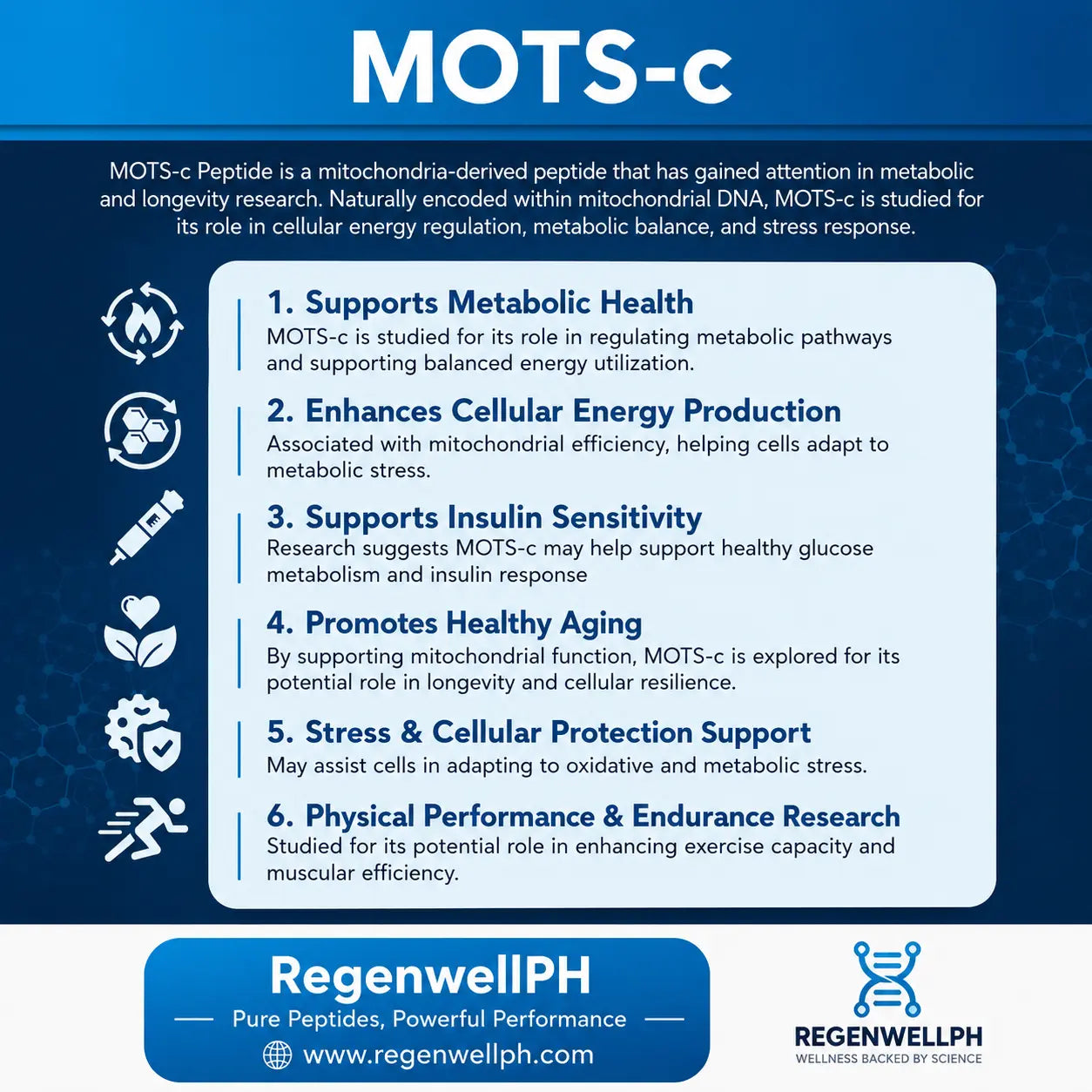
Within the aging and mitochondrial-support space, MOTS-c is sometimes mentioned alongside compounds like NAD+ precursors and Epitalon. Comparing the two highlights the gap between an established therapeutic class and an emerging research peptide, a distinction covered in our overview of the GLP-1 class. Repair-focused peptides such as BPC-157 and TB-500 are studied primarily for tissue healing and recovery — acting mainly on local repair processes and angiogenesis. However, the absence of reported harm in mice is not the same as demonstrated safety in humans, especially over the long term or at supraphysiologic doses.
This guide examines the scientific basis of MOTS-c, utilizing recent studies up to 2026, enabling you to make an educated decision in consultation with your primary care provider. Across various independent laboratories, animal studies consistently demonstrate metabolic advantages, supporting the relevance of translational application. According to D’Souza et al. 2022 — administering MOTS-c to older mice enhances exercise capacity and boosts mitochondrial function to levels similar to younger animals.
These quality controls cost more but provide assurance that what you are injecting is actually what you intend. Sourcing high-quality peptides from verified vendors dramatically reduces contamination-related adverse events. Sleep quality becomes even more important during MOTS-c protocols. Taking doses on workout days, particularly before exercise, can enhance the synergy between exogenous MOTS-c and exercise-induced AMPK activation.
The improved physical capacity in old mice — the effects on age-related insulin resistance and the bone findings all feed interest in MOTS-c for healthy aging (7). In mice with surgically induced menopause (a standard model for osteoporosis), it reduced bone loss. Many popular peptides, such as CJC-1295 or ipamorelin, work by making the pituitary gland release more growth hormone. Almost all of that work is preclinical — which means cells and animals. It is one of a small group of mitochondrial-derived peptides (alongside humanin), that researchers have studied as signals sent from the mitochondria to the rest of the body.
Companies typically charge $60 or more for a 10mg supply and do not provide larger quantities, which is significant since a 10mg dose depletes in approximately a week at a practical dosage. When considering MOTS-c, the quality is more critical than with many other peptides due to its rapid degradation once mixed. Growth Hormone Releasing Peptide-2 , GHRP-2, stands out as one of the most extensively researched synthetic peptides within the growth hormone secretagogue category.
This is important for anyone who is worried about muscle loss due to aging or during weight reduction. It is also a contributing factor to muscle wasting associated with obesity and insulin resistance. They exceeded the performance levels of untreated middle-aged animals. Individuals exhibiting lower levels of MOTS-c generally have higher BMIs (increased abdominal fat), elevated fasting insulin levels, and poorer scores on insulin resistance. The response was consistent and dependent on the dose across several studies.

MOTS-c is real, scientifically credible biology, a 16-amino-acid peptide encoded in the mitochondrial genome that functions as a stress-response signal linking mitochondrial energy status to nuclear gene regulation. If you are managing a protocol like this, StackMyMed , our companion app, keeps your doses, timing, and interaction checks in one place. Whether this effect is sustained with regular training and whether it is meaningful for health outcomes in humans is not yet established by controlled trials. The mechanism by which exogenous MOTS-c crosses the cell membrane is not established. Endogenous MOTS-c is a real and biologically significant molecule.